The value is leaving.
We built the plant to keep it.
Ghana grows a quarter of a million tonnes of cashew a year and keeps less than a tenth of the processing. The government has just moved to change that. We are positioned at the exact point where policy, supply and demand meet.
Four things are pointing the same way
None of these is a forecast. Each is either policy already announced, or supply already in the ground.
Policy tailwind
In February 2026 the government declared an end to raw cashew exports, targeting 50–60% local processing through the Tree Crops Development Authority.
Supply abundance
Ghana produces roughly 250,000 tonnes of raw cashew a year. The feedstock exists; the processing capacity does not.
Demand growth
Global kernel demand continues to rise, and EU and US buyers increasingly require traceable, deforestation-free origin.
Margin capture
Processing at origin captures the conversion margin that currently leaves the continent with the raw nut.
A gap this wide is the opportunity
Ghana is among the largest cashew producers in West Africa, yet the overwhelming majority of its crop is shipped out raw to be processed in Asia and re-exported at a multiple of its origin value.
The Tree Crops Development Authority estimates the sector could generate more than US$660 million annually through stronger regulation, increased processing and expanded value addition.
Sources: Ghana Tree Crops Development Authority; Association of Cashew Processors Ghana; Ghana Tree Crops Investment Summit, February 2026.
Less than a tenth of the national crop is processed domestically.
The stated ambition under the policy announced in February 2026.
Leaves the continent to be processed and re-exported at a multiple of origin value.
The same tonne, two destinations
This is the entire argument in one comparison. The figures below must be completed from our current contracts and cost base before this page is shown to anyone outside the company.
Today — exported raw
Raw nut leaves the country
Raw cashew nut, per tonne
[ ]
Processing margin retained in Ghana
None
Jobs created per tonne
Minimal
Buyer relationship
Trader / re-exporter
With us — processed at origin
Finished kernel leaves the country
Kernel yield per tonne of raw nut
[ ] % outturn
Kernel value, per tonne
[ ]
Conversion margin retained
[ ]
Buyer relationship
Direct to importer / brand
Kernel outturn ratio (KOR) is the share of a raw nut lot that emerges as whole kernel, typically in the low twenties by percentage. It is the single most important variable in cashew processing economics.
Our position today
An honest statement of what is built, what is contracted and what is still ahead. Every figure here is to be completed before circulation.
- Facility: [location, size and operational status to confirm]
- Installed capacity: [tonnes per year to confirm]
- Team: [headcount and gender split to confirm]
- Offtake: [signed agreements or LOIs to confirm]
- Certifications: [held vs in progress to confirm]
Capacity, in three phases
Tonnage and timing to be completed from the operating plan.
Establish
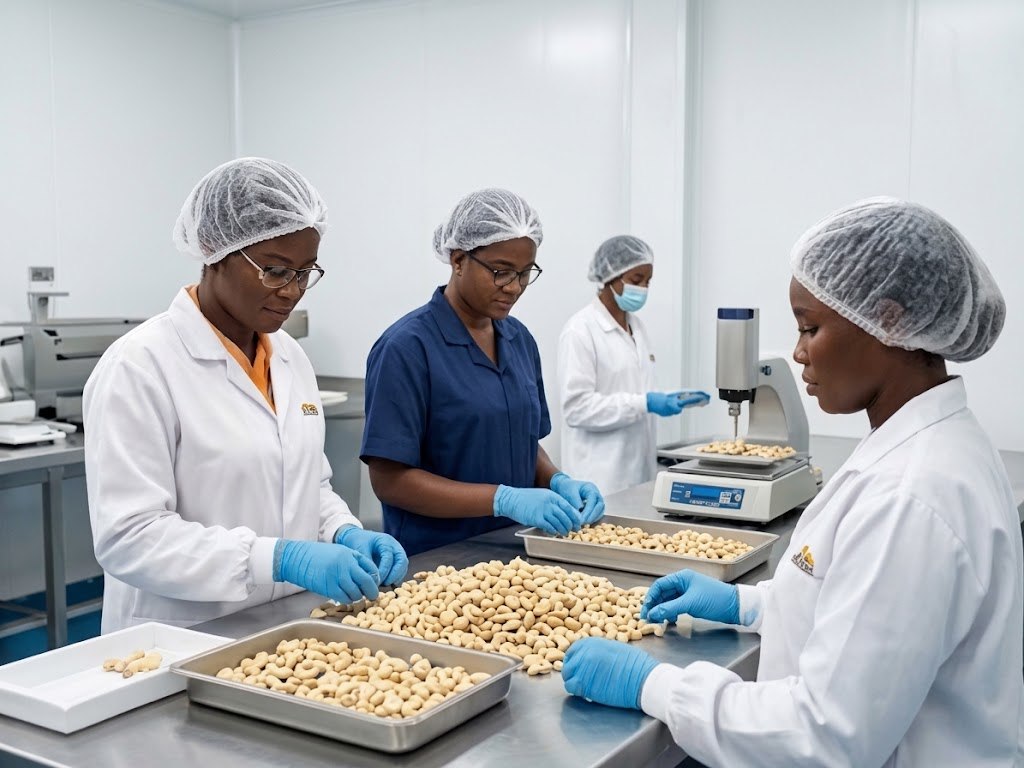
Commission the line, achieve food-safety certification and prove consistent grade output against contract specification.
Scale
Expand shifts and throughput, deepen the outgrower network and secure repeat offtake with named buyers.
Integrate
Add by-product streams — cashew nut shell liquid and cashew apple — and move into branded and private-label formats.
Where the capital goes
Allocation to be completed once the raise is structured. We will publish the split rather than describe it in general terms — investors are entitled to the detail.
A visual allocation chart replaces this table once the percentages are confirmed.
Processing equipment & installation
[ ]%
Working capital — raw nut purchase
[ ]%
Facility, power & utilities
[ ]%
Certification & compliance
[ ]%
Team, training & systems
[ ]%
Contingency
[ ]%
Returns and development outcomes are the same trade here
This is what makes the business eligible for blended finance and development capital that a pure trading operation cannot access.
Employment at origin
Processing a tonne in Ghana creates roughly eight to ten times the local employment of shipping it out raw.
Women in the workforce
Cashew processing is overwhelmingly staffed by women. Scale here is female employment at scale.
Farmer incomes
A domestic buyer of scale changes the price a smallholder can negotiate for their harvest.
EUDR readiness
Geolocated, deforestation-free sourcing is becoming a hard gate for EU buyers. Being early converts a compliance cost into a commercial advantage.
What could go wrong, and what we do about it
We would rather name these than have you find them. Each is a real constraint in this industry.
Commodity price volatility
Raw cashew and kernel prices move with the West African harvest and Asian demand. We manage exposure through contract structure, forward pricing where available and disciplined inventory turns. [Detail to complete.]
Foreign exchange
Revenue is largely in hard currency while a share of costs is in cedi. Natural hedging plus banking arrangements reduce, but do not remove, this exposure. [Detail to complete.]
Harvest variability and climate
Yield varies with rainfall and flowering conditions. A broad and geographically spread outgrower network is the primary mitigation. [Detail to complete.]
Power and utilities
Reliable power is a known constraint for Ghanaian manufacturing. [Backup generation and solar strategy to confirm.]
Working capital intensity
Cashew processing is working-capital heavy because raw nut must be bought in a concentrated buying season and converted over the year. This is the single largest funding requirement and is treated as such.
Quality and food safety compliance
A failed shipment is both a financial and reputational event. Certification, in-line QA and documented traceability are the controls. See our quality page.
Who you would be backing
Trust in commodity trade is personal. Most of our competitors are faceless online; we will not be.

[Name to confirm]
[Short track record — prior roles, sector experience, what they bring. To confirm.]
[Name to confirm]
[Short track record — prior roles, sector experience, what they bring. To confirm.]
[Name to confirm]
[Short track record — prior roles, sector experience, what they bring. To confirm.]
Request access to the data room
Financial model, capacity plan, certifications, offtake documentation and the full investor brief. Released under NDA to qualified investors.
Investor FAQ
What stage is the business at?
[To confirm — operational, commissioning or pre-build, with the facility status and current throughput.]
What are you raising, and in what instrument?
[To confirm — amount, instrument (equity, convertible, debt or blended), and intended close.]
How is raw cashew supply secured?
Through a direct outgrower network and buying arrangements across Ghana’s cashew belt, which reduces dependence on spot-market purchasing during the buying season. [Network detail to confirm.]
Who are the buyers?
[To confirm — signed offtake agreements, letters of intent and live commercial conversations, with regions served.]
What certifications do you hold?
[To confirm.] Our priority is the ACA Quality & Sustainability Seal, which complies with the US Food Safety Modernization Act and is recognised by major international buyers, alongside HACCP and ISO 22000.
What does the exit look like?
[To confirm — trade sale, strategic partnership or dividend path, with indicative horizon.]