The most sustainable thing
we do is finish the job here
Every tonne processed in Ghana is wages, skills and value that stays in Ghana. The rest of this page is detail on that one idea.
Shipping a crop out raw is the waste
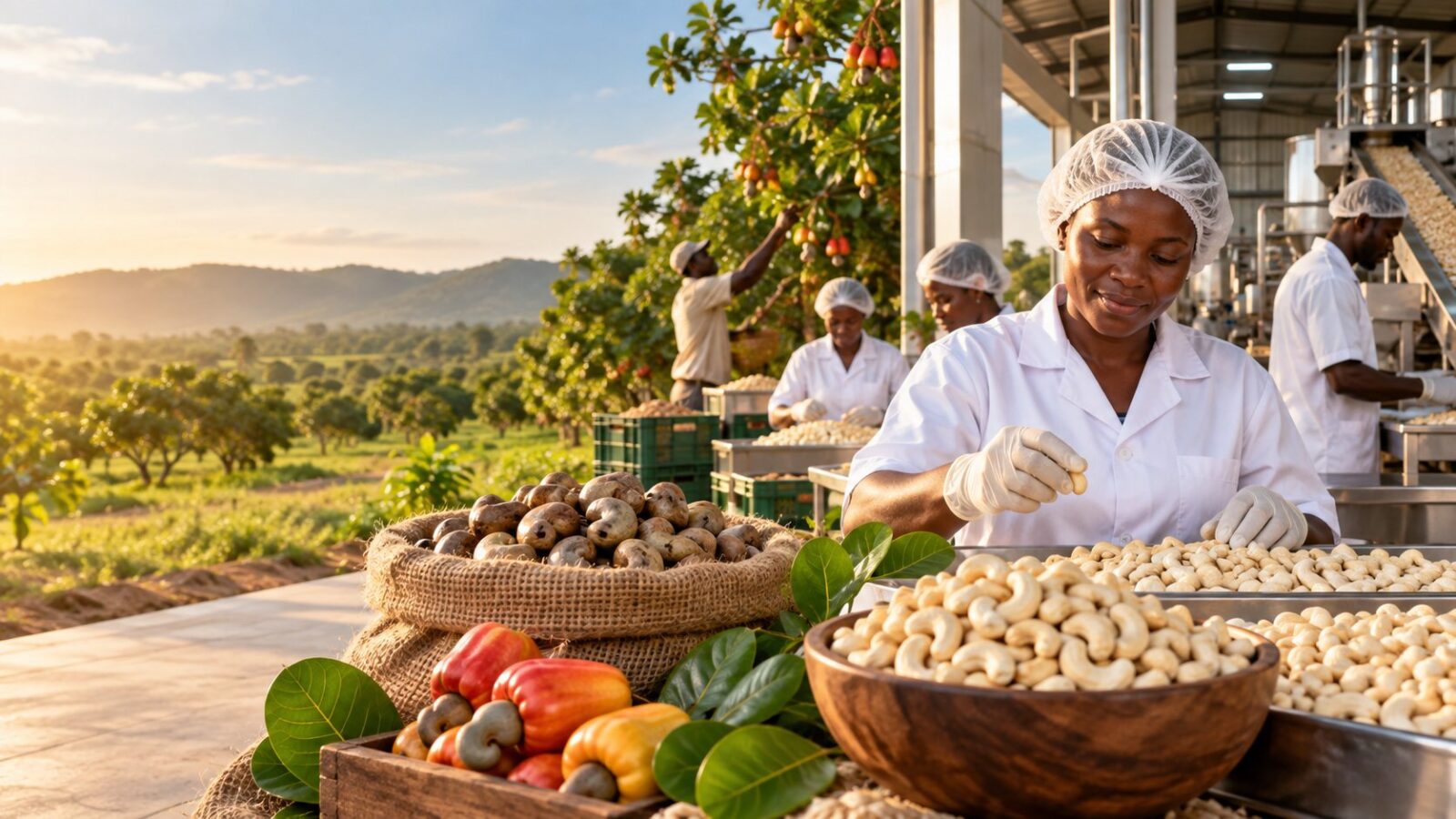
Ghana grows roughly 250,000 tonnes of raw cashew a year and processes less than a tenth of it at home. The rest travels to Asia to be shelled, peeled, graded and packed, then travels again to the markets that eat it.
That is two long sea legs and an entire conversion margin leaving the continent, for a job that can be done a few kilometres from the tree. Processing at origin is not an environmental add-on to this business. It is the business.
A domestic buyer changes what a farmer can negotiate
Smallholders selling into a market with one realistic route out have very little pricing power. A processor buying at scale, locally, in season, changes that arithmetic.
Direct purchase
We buy from farmers directly rather than through layers of aggregators. [Network size to confirm.]
Transparent pricing
Price, moisture and outturn shown at the point of purchase, not decided afterwards.
Agronomy support
Pruning, spacing and post-harvest handling advice that lifts both yield and outturn. [Programme to confirm.]
Prompt payment
Payment terms that respect the fact that a harvest is a household’s annual income. [Terms to confirm.]
Cashew processing is women’s work, at scale
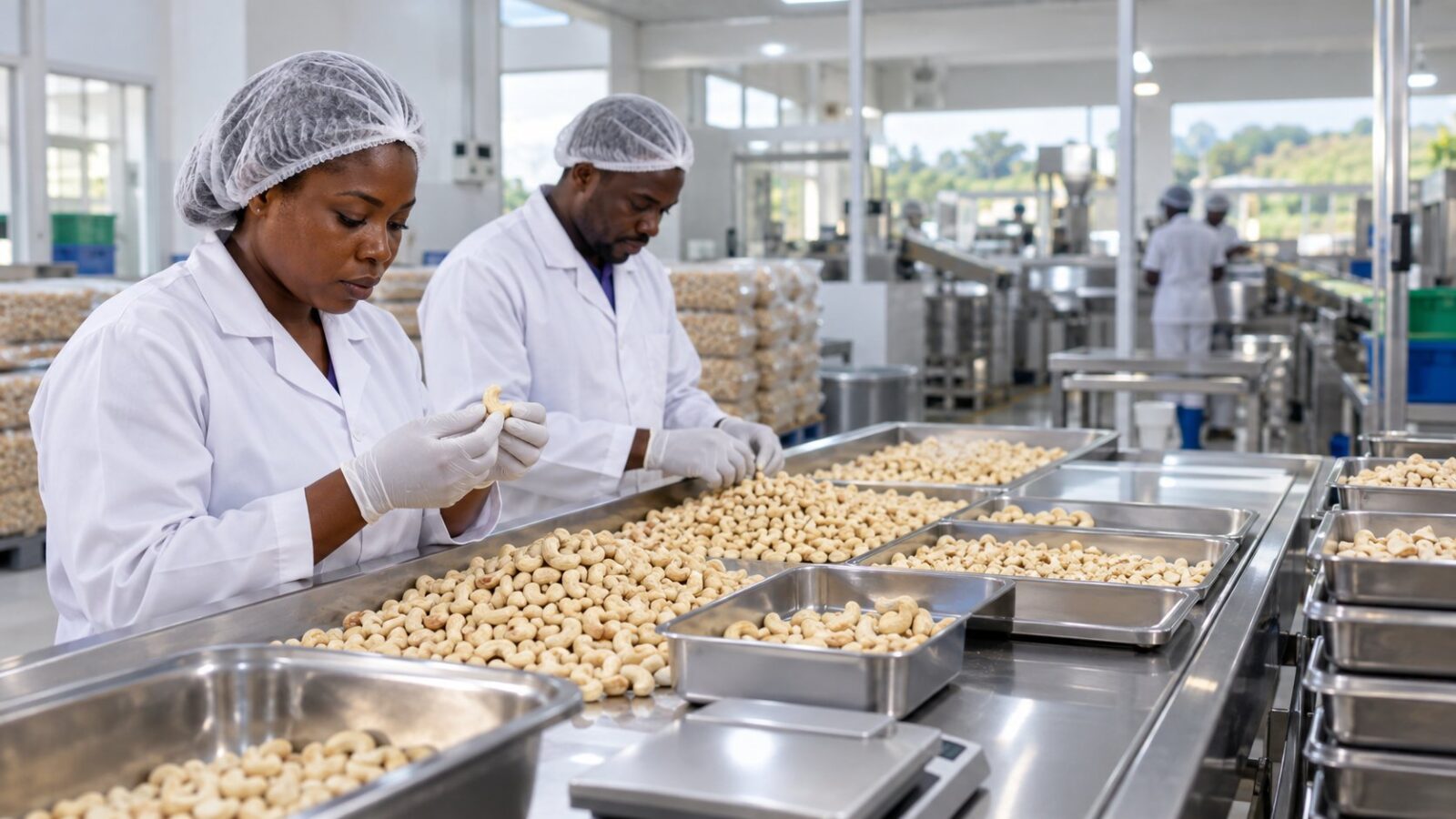
Across West Africa, cashew processing floors are staffed overwhelmingly by women. Grading, peeling and inspection are skilled roles, and they are where most of the employment in this industry actually sits.
Scaling a processing business here is therefore female employment at scale — not as a programme bolted onto the side of the company, but as the direct consequence of running it.
[Headcount and gender split to confirm.]
Three products from one fruit
A cashew tree yields a nut, a shell and an apple. Conventional processing uses the first, burns the second and abandons the third.
The kernel
The product everyone buys. Graded, packed and exported — roughly a fifth of the raw nut by weight.
The shell
Cashew nut shell liquid is a genuine renewable industrial feedstock for resins, friction materials and coatings. Recovering it turns a disposal cost into revenue.
The apple
The overwhelming majority of the fruit by weight, and almost universally left to rot in the field. Juice, vinegar and dried fruit are the routes out.
Deforestation-free, and able to prove it
The EU Deforestation Regulation requires importers to show that a commodity was not grown on land deforested after the cut-off date, with geolocation data for the plots it came from. For cashew this is a real operational requirement, not a form to sign.
We would rather be early than compliant at the last minute. Buyers who need EUDR evidence are exactly the buyers worth having, and a supplier who already holds the data is a much easier supplier to say yes to. [Current status to confirm.]
Plot geolocation
Sourcing mapped back to the plots it came from.
Deforestation-free
Evidence that land was not cleared to grow what we buy.
Due diligence record
Documentation an EU importer can actually file.
Annual review
Re-verified each season rather than signed once.
The returns and the outcomes are the same trade
This is what makes the business eligible for development and blended finance that a pure trading operation cannot reach.