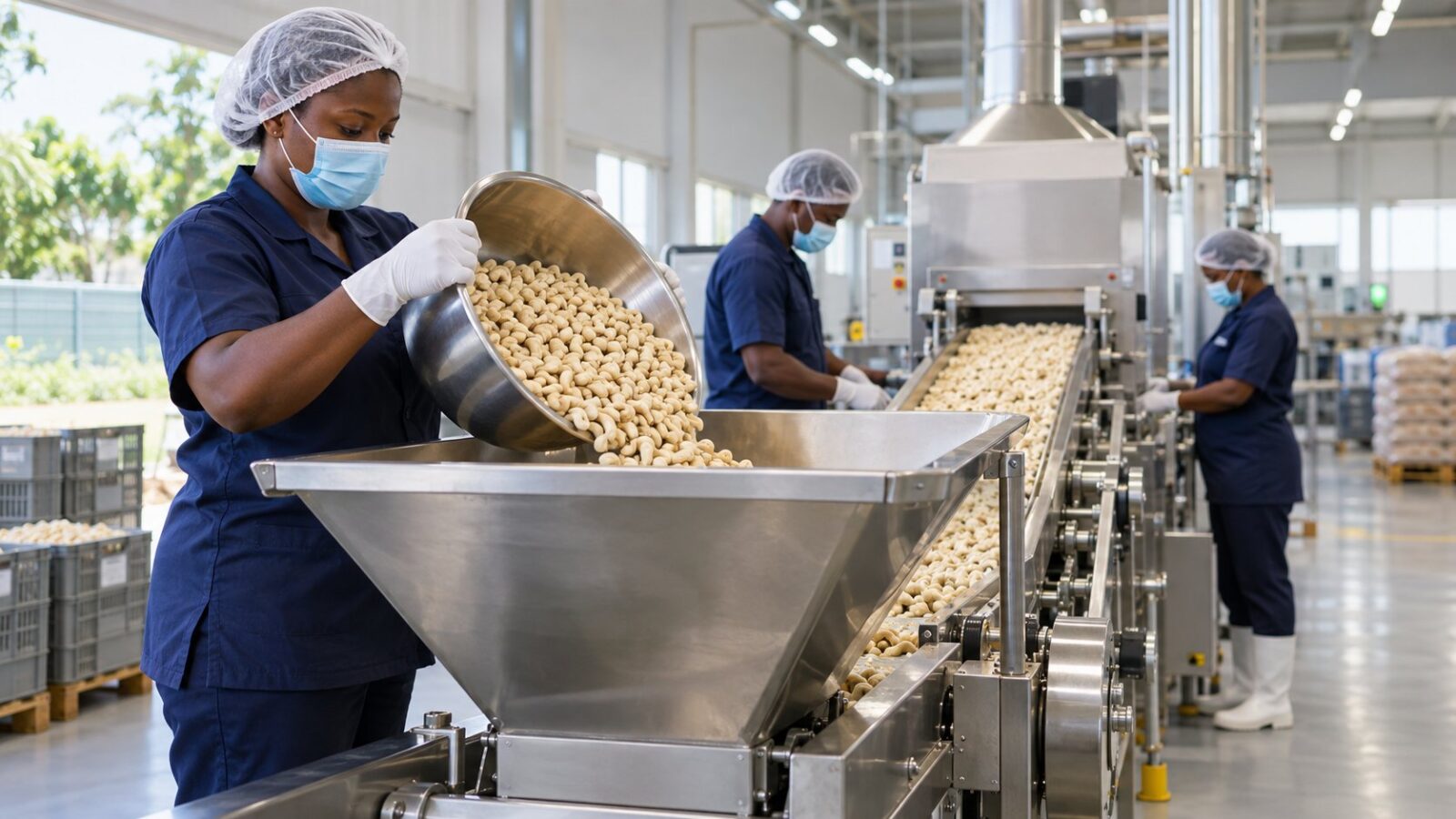
Africa grows an enormous share of the world’s raw cashew and, until recently, processed almost none of it. Between 2000 and 2019 the overwhelming majority of African cashew left the continent still in its shell, to be shelled, peeled, graded and packed somewhere else — then sold back into the same global market at a multiple of what the farmer received.
That is beginning to change. By 2025 roughly a fifth of African cashew production was being processed on the continent. This piece is about why the rest went abroad in the first place, what has shifted, and what actually makes an African processor competitive rather than merely local.
Where the value sits in a cashew
A raw cashew nut is mostly shell. The kernel inside is the product with food value, and getting it out intact is skilled, capital-hungry work. Each step away from the raw nut adds value — and historically each step happened further from the farm.
| Stage | What happens | Where it has traditionally happened |
|---|---|---|
| Growing and harvesting | Nuts collected, dried, bagged | The producing country |
| Primary processing | Shelling, peeling, grading into kernel grades | Overwhelmingly Asia |
| Secondary processing | Roasting, salting, flavouring, packing | Asia and consuming markets |
| Branding and retail | Packaging, distribution, shelf | Consuming markets |
The farmer participates in the first row. Almost all of the value created in the rows beneath it accrues somewhere else.
Why processing went to Asia
It is worth being clear-eyed about this, because the reasons were real and several still apply.
- Established capacity and skill. Decades of accumulated expertise in shelling and peeling, and a workforce trained in it.
- Access to capital. Cashew processing is working-capital intensive; buyers must purchase a year’s raw nut in a short season and convert it across the following months.
- Scale. Large plants absorb fixed costs better and can serve big buyers consistently.
- Logistics and finance. Reliable power, freight and trade finance at sensible cost.
What has actually changed
Four things, and they compound.
Policy. Producing countries have moved from encouraging value addition to requiring it. Ghana has signalled an end to raw cashew exports with a target of 50 to 60 per cent local processing — what that means for buyers.
Buyer interest in origin. Traceability has moved from a nice-to-have to a procurement question. A chain with fewer hops is easier to document, and origin processing shortens it.
Freight arithmetic. Shipping raw nut means shipping shell. Processing at origin removes a sea leg and a great deal of weight that was never going to be eaten.
Employment economics. Cashew processing is labour-intensive in exactly the places that need employment, and it is work that is overwhelmingly done by women.
The employment case, with real numbers
Estimates vary with the degree of mechanisation, which is why a single figure should always be treated carefully. A value chain analysis of West African cashew processing put local processing at roughly 80 to 200 jobs per 1,000 tonnes of raw cashew, depending on how mechanised the operation is. The International Nut and Dried Fruit Council has estimated that processing a tonne locally can create up to ten times more jobs than exporting it unprocessed.
The African Cashew Alliance reports that over 2.5 million Africans are employed directly and indirectly by the cashew industry, and that it is the main source of income for around 1.8 million families in West Africa. The Alliance also estimates that processing locally creates up to two and a half times more value for producing countries than exporting raw.
The constraints nobody should gloss over
Origin processing is not automatically profitable, and pretending otherwise does the argument no favours.
| Constraint | Why it bites | What mitigates it |
|---|---|---|
| Working capital | Raw nut is bought in weeks and sold across a year | Structured seasonal finance; disciplined inventory turns |
| Power reliability | Interruptions stop lines and spoil batches | Backup generation; energy planning |
| Skills | Calibration, conditioning and peeling are learned crafts | Training, retention, and time |
| Certification cost | International buyers expect audited food safety | Schemes such as the ACA Seal, designed for this gap |
| Price volatility | Raw nut and kernel prices move independently | Contract structure and forward commitments |
What makes an African processor genuinely competitive
Not proximity to the crop. Everyone at origin has that. The differentiators are narrower and more technical:
- Outturn discipline. Buying raw nut on measured kernel outturn rather than estimate is the difference between a margin and a hope.
- Grade mix. Recovering kernel is not enough; recovering it whole is where the money is.
- Consistency. Buyers do not pay for a good batch. They pay for every batch being the same.
- Documentation. Certificates, analyses and lot traceability turn a claim into something a compliance team can file.
- Reliability of supply. Being there next season, and the one after.
Why this matters beyond the balance sheet
A tonne processed in Ghana is wages paid in Ghana, skills built in Ghana and export earnings retained in Ghana. The same tonne shipped out raw is a commodity transaction that leaves very little behind.
That is the whole argument, and it is why we built where the crop grows. How we process, what it means locally, and the investment case set out the rest. If you are buying, tell us your grade and volume.
Sources: CBI value chain analysis of West African cashew processing; International Nut and Dried Fruit Council; African Cashew Alliance.