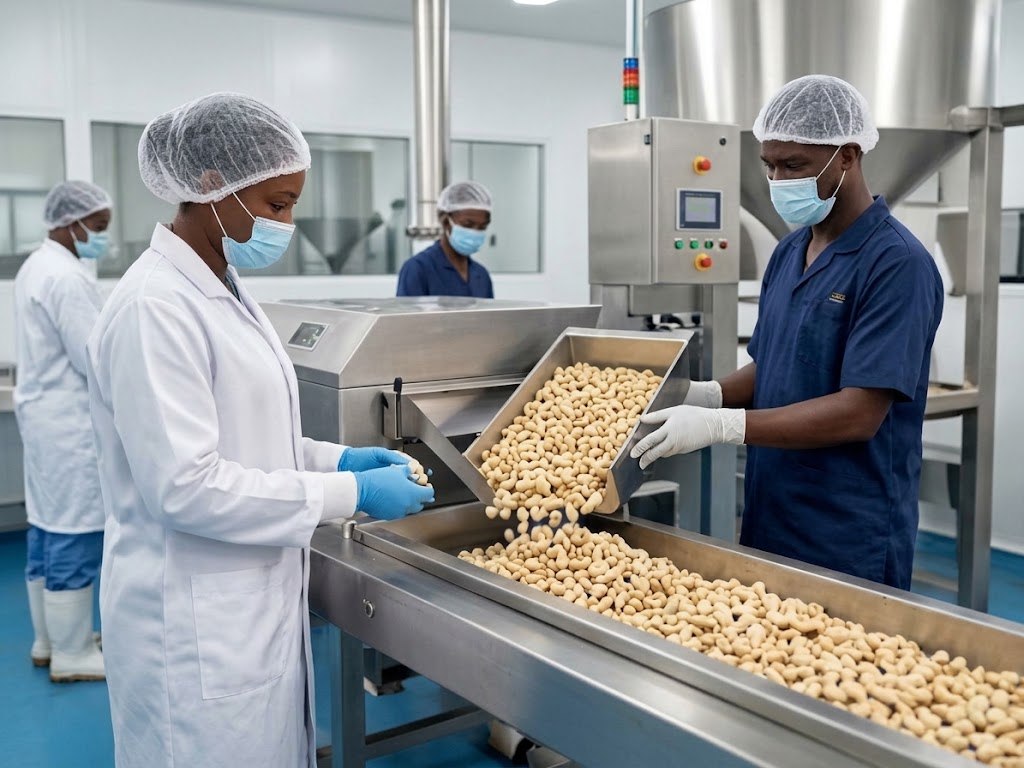
A whole white cashew kernel is worth substantially more than the same kernel in two pieces. Nothing else about it has changed — not the taste, not the food safety, not the nutrition. It simply broke, and in breaking it moved from the top of the price list to somewhere much further down.
That is why breakage is the quietest way to lose money in cashew processing. It does not appear as a failure. It appears as a slightly worse grade mix, month after month.
What a broken kernel actually costs
When a whole kernel breaks it leaves the white whole grades entirely and becomes a butt, a split or a piece. Those grades have genuine markets — bakery, confectionery, ingredient use, nut butter — and they are not waste. But they sell for materially less than the whole grades, and the gap is the processor’s margin.
A processor recovering plenty of kernel by weight can still be losing money if too much of it is broken. This is the distinction between outturn and grade mix: outturn tells you how much kernel came out, grade mix tells you what it is worth.
Where kernels actually break
Breakage is not one event. It accumulates across six stages, and each one is controllable.
| Stage | What goes wrong | What prevents it |
|---|---|---|
| Drying the raw nut | Over-dried nuts become brittle; under-dried nuts shell badly and mould | Controlled drying to a target moisture, measured rather than judged by eye |
| Calibration | Mixed nut sizes fed into equipment set for an average | Sizing nuts into bands so the machine is set correctly for each one |
| Steam conditioning | Too little and the shell grips the kernel; too much and the kernel softens | Time and pressure matched to the size band, not a single setting for everything |
| Shelling | Cutting blades set wrong for the nut size crush the kernel | Settings adjusted per band, and equipment maintained rather than run to failure |
| Drying before peeling | Testa will not release cleanly, so peeling forces it | A second controlled dry that loosens the skin before the kernel is handled |
| Peeling and handling | Aggressive peeling, long drops, over-filled trays | Gentler peeling, shorter falls, hand finishing where the grade justifies it |
Calibration is the biggest single lever
If a processing line is only going to get one thing right, it should be calibration. Shelling equipment works by cutting or cracking the shell along a predictable line. That line depends on the size and shape of the nut. Feed a machine a mixture of large and small nuts on one setting and it will be correct for the middle of the range and wrong at both ends.
Sizing the nuts first, and adjusting the equipment for each band, converts a machine that is approximately right into one that is precisely right. It is unglamorous, it slows the line slightly, and it is the difference between a good grade mix and a mediocre one.
Moisture is the second
Moisture governs how the kernel behaves under stress. Too dry and it snaps rather than flexes. Too wet and it will not release from the shell cleanly, and it carries mould risk into storage as well.
There is a narrow window in which a kernel is resilient enough to survive shelling and dry enough to store, and hitting it repeatedly is a matter of measurement. This is why we test moisture at intake and again through processing, rather than treating it as something that either is or is not a problem.
The peeling window
After shelling, the kernel still carries the testa — the thin reddish skin around it. Peeling works best when a second controlled drying has loosened that skin. Peel too early and the skin clings, so the process has to be more aggressive and the kernel scratches or splits. Peel too late, after the kernel has cooled and hardened too far, and it becomes brittle.
Where the grade justifies it, hand finishing catches what machines cannot: kernels with a little testa remaining, or that need careful separation rather than force. It is slow, it is skilled, and it is one of the reasons cashew processing employs so many people.
What a buyer can infer from grade mix
You will rarely be shown a processor’s breakage rate. You can infer a great deal from what they offer you.
- A supplier who can consistently commit to whole white grades at volume is running a line under control
- A supplier whose offers swing unpredictably between grades is not
- A supplier pushing hard to sell you brokens is often clearing a problem rather than serving a need
None of that is proof, but it is signal — and it is worth more than an assurance about quality.
Questions worth asking
- Do you calibrate nuts by size before shelling?
- What moisture target do you work to, and how is it measured?
- Is peeling machine-only, or is there hand finishing?
- What is your typical whole-to-broken ratio, and can you show the grading record for a recent lot?
- How is kernel handled between peeling and packing?
A processor who has thought about breakage will answer these in detail and without defensiveness, because the answers are their craft. Our own process sets out each of the eleven steps, and the checks that sit around them.
The short version
Whole kernels are not a lucky outcome. They are the result of drying to a measured target, sizing before shelling, conditioning to match the size, and handling the kernel as though it is fragile — because it is. Everything else is recovery.
See how the grades are classified, or ask us what we can commit to for your volume and grade.