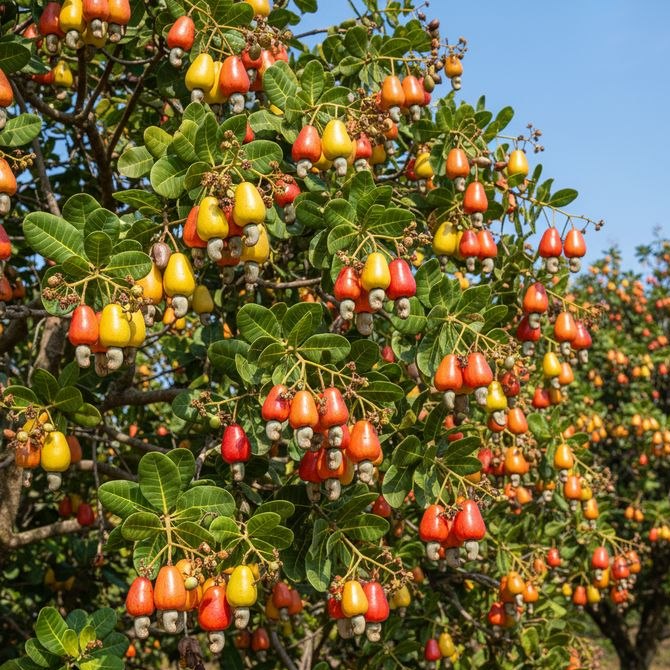
If you buy raw cashew, one number decides whether the purchase makes money: kernel outturn ratio. Everything else — the price per tonne, the moisture reading, the look of the sack — is secondary to how much saleable kernel actually comes out of the lot.
It is also the number most often estimated rather than measured, which is exactly why it is worth understanding properly.
What kernel outturn ratio is
Kernel outturn ratio, usually shortened to KOR, is the share of a raw cashew lot that emerges as usable kernel after shelling and peeling. A raw cashew nut is mostly shell. Only the kernel inside has commercial value as food, and the proportion varies from lot to lot.
You will see KOR written two ways. Processors and buyers in the international trade often express it as pounds of kernel recovered per 80 kilogram bag of raw nut. Elsewhere it is simply a percentage of the raw weight. Both describe the same thing. What matters is that the contract states which convention it uses, because the two numbers are not interchangeable.
Why it decides the economics
Consider two lots offered at the same price per tonne. If one yields meaningfully more kernel than the other, it is the cheaper lot — sometimes dramatically so — even though the headline price is identical. A processor buying on price per tonne without knowing outturn is not buying raw cashew. They are buying a lottery ticket.
This is why experienced buyers talk about the cost per kilo of kernel, not the cost per tonne of raw nut. It is the only figure that connects a purchase to what can actually be sold.
How outturn is measured: the cut test
Outturn is established by cut test, and the method matters:
- A representative sample is drawn from across the lot, not from one convenient corner of it
- The sample is counted and weighed
- Each nut is cut open
- Kernels are separated into good whole kernel, broken kernel, and rejects — immature, shrivelled, mouldy, insect-damaged or empty
- The usable kernel is weighed, and the result is expressed against the sample weight
Done properly this takes time and produces a number you can price against. Done casually — a handful of nuts from the top of one bag — it produces a number that suits whoever is holding the knife.
We cut test on arrival and report the result against the lot. Farmers selling to us watch the test happen, because a price that follows from a measurement neither side disputes is a better basis for a relationship than a price argued over a sack.
What moves outturn up or down
| Factor | Effect on outturn | Where it is decided |
|---|---|---|
| Nut maturity | Immature nuts give shrivelled or empty kernels | In the orchard, at harvest timing |
| Moisture | Wet nuts lose weight and risk mould in storage | Drying immediately after collection |
| Storage conditions | Damp or pest-exposed storage degrades kernel | On the farm and in the warehouse |
| Handling | Rough handling cracks shells and exposes kernel | Collection, bagging, transport |
| Nut size and consistency | Mixed sizes shell less cleanly | Orchard management and calibration |
| Time since harvest | Long delays reduce recoverable kernel | Logistics between farm and processor |
Notice how much of that column on the right happens before a processor ever sees the lot. Outturn is largely decided in the weeks around harvest, which is why the harvest calendar and post-harvest handling matter so much to a buyer who will never set foot in an orchard.
What a good outturn looks like
We deliberately do not publish a target figure here, and you should be cautious of anyone who does without qualification. Outturn varies by origin, by season, by region within a country, and by how the crop was handled after it fell. A number quoted as typical, with no lot behind it, is marketing rather than information.
The useful question is not what outturn is normal. It is what outturn this lot gives, measured, with the method stated.
Why estimates persist
Estimated outturn survives because it is useful to the seller. An estimate is a negotiating position dressed as a fact. It costs nothing to assert and it is difficult to disprove until the lot has already been shelled, by which point the money has changed hands.
The counter is simple and not especially sophisticated: test before you price, use a representative sample, write the method into the contract, and keep the retained sample.
A worked example: why price per tonne misleads
The figures below are illustrative rather than market quotes — they exist to show the arithmetic, not to suggest a price. Suppose you are offered two lots of raw cashew at the same headline price, and one yields a fifth more usable kernel than the other.
| Lot A | Lot B | |
|---|---|---|
| Price per tonne of raw nut | Same | Same |
| Usable kernel recovered | Lower | Higher by about a fifth |
| Effective cost per kilo of kernel | Higher | Lower |
| Which is the cheaper lot? | — | Lot B, decisively |
Nothing about the sacks, the price list or the conversation would tell you this. Only the cut test does. A buyer who runs the test converts a headline price into the only number that matters: what the saleable product actually costs.
Outturn and grade mix are not the same thing
A lot can give a good total outturn and still disappoint, if too much of that kernel comes out broken. Outturn tells you how much kernel you recovered. Grade mix tells you what it is worth, because whole white grades command more than splits and pieces.
Both matter, and they are influenced by different things. Outturn is largely set before the nut reaches the factory, by maturity, drying and storage. Grade mix is heavily influenced by what happens inside the factory — calibration before shelling, steam conditioning, and how carefully kernels are handled through peeling. The grades we sell are the visible result of that second stage.
What to write into a raw nut purchase contract
- The outturn convention being used — percentage of raw weight, or pounds of kernel per 80kg bag
- The sampling method, including how many bags are sampled and from where in the lot
- Who performs the cut test, and whether both parties are present
- Maximum moisture at delivery, and how it is measured
- Tolerances for immature, mouldy and insect-damaged nuts
- What happens if the measured outturn falls below the agreed figure — repricing, rejection, or partial acceptance
That last point is the one most often left out, and the one most likely to be needed.
For farmers: how to protect your own outturn
Outturn is not only a buyer’s concern. It is the difference between a fair price and a low one, and much of it is within a farmer’s control.
- Collect nuts promptly once the fruit has fallen, rather than leaving them on damp ground
- Separate the nut from the cashew apple quickly
- Dry thoroughly before bagging — this is the single biggest lever
- Store off the ground, dry and away from pests
- Do not mix immature nuts into a load to make up weight; they fail the cut test and drag the price of the whole lot down
A load that has been handled well tests better, prices better, and is worth more to both sides. That is not a favour to the buyer. It is the mechanism by which good practice gets paid for.
What this means if you buy kernel rather than raw nut
If you buy finished kernel, outturn is not your direct problem — but it shapes your supplier. A processor who buys raw nut carelessly ends up with thin margins and pressure to make them up somewhere, usually in grading tolerance or documentation. A processor who measures what they buy is a processor whose kernel specification you can rely on.
That is the honest reason we write about this at all. Our process starts with the cut test, and the grades we sell are the output of it.