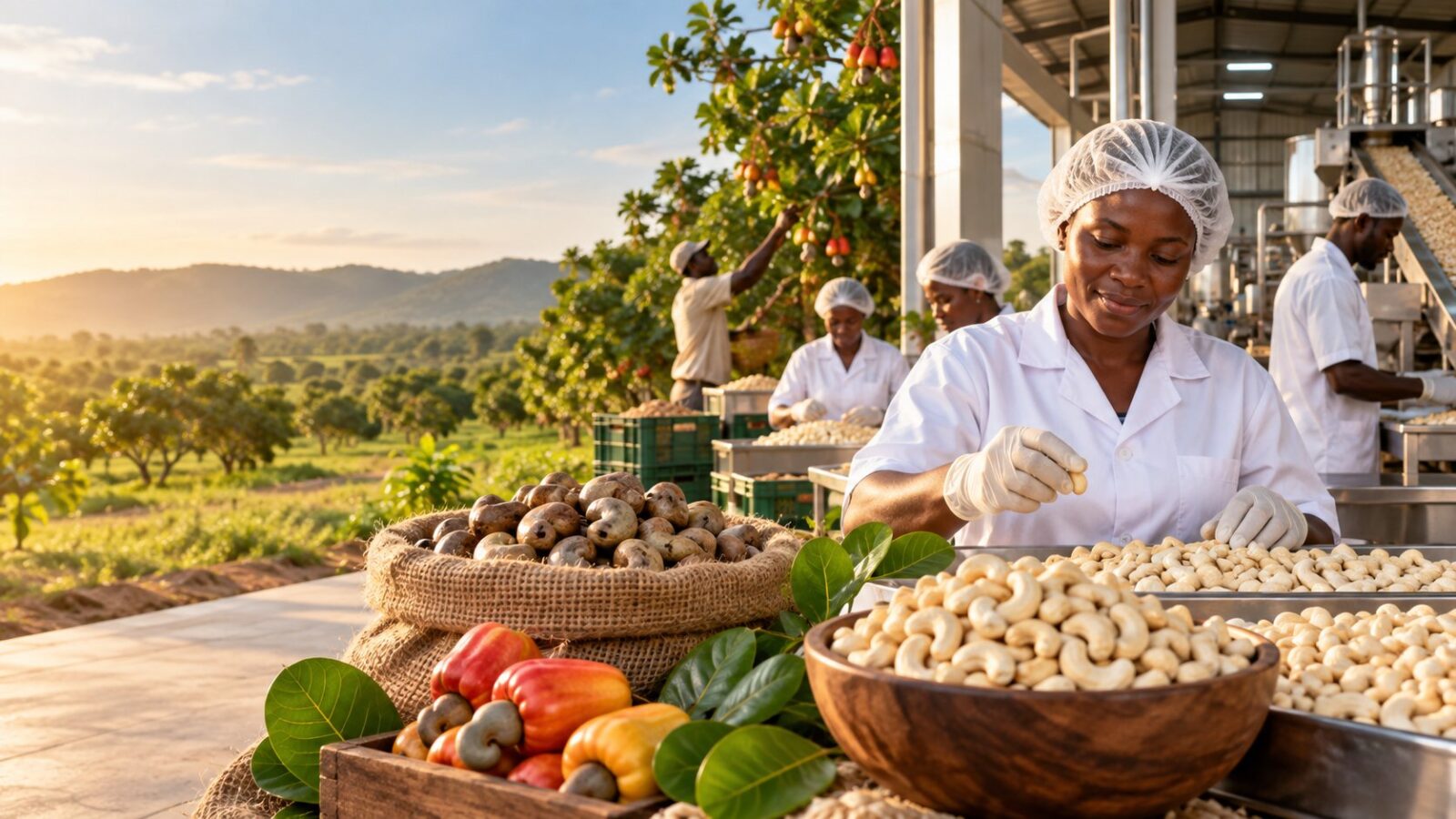
On 17 February 2026, at the inaugural Ghana Tree Crops Investment Summit in Accra, President John Dramani Mahama said something the cashew trade had been expecting for years: “We will no longer export raw cashew.”
For anyone buying cashew from West Africa, that sentence changes the shape of the supply base. Here is what it means in practice, what is still uncertain, and what buyers should do about it.
What was actually announced
The government set out an intention to end raw exports of cashew, shea and rubber, and to move Ghana toward processing a far larger share of its own crop. The stated target is roughly 50 to 60 per cent local processing, supported by expanded agri-industry parks, incentives for private processors, and stronger regulatory oversight through the Tree Crops Development Authority.
The Authority has estimated that Ghana’s cashew sector could generate more than US$660 million a year through stronger regulation, increased processing and expanded value addition.
The gap the policy is aimed at
| Measure | Position |
|---|---|
| Ghana’s annual raw cashew production | Around 250,000 tonnes |
| Share processed domestically | Historically under 10 per cent |
| Government target for local processing | Roughly 50–60 per cent |
| Sector potential per year, per the Tree Crops Development Authority | More than US$660 million |
| Processing target of the Association of Cashew Processors, Ghana | 85,000 tonnes annually by 2026 |
The continental picture is similar in shape. Between 2000 and 2019 the overwhelming majority of African cashew left the continent as raw nut in shell. By 2025 roughly a fifth of African production was being processed in Africa — real movement, from a very low base. We look at why the value went abroad in the first place in the economics of processing cashew in Africa.
What it means if you buy cashew kernel
More origin supply, and a wider supplier base
If the policy holds, more Ghanaian raw nut stays in Ghana and more of it is shelled here. For a buyer that means a growing pool of kernel available directly from origin, rather than via Asia. Shorter chains, fewer intermediaries, and the ability to trace a lot back to the region it grew in.
More new entrants — which cuts both ways
Rapid capacity build attracts operators of every standard. Some will be excellent. Some will be commissioning a line for the first time while learning what a cut test is. The burden of due diligence rises, not falls.
In a market like this the useful questions are unglamorous. Does the supplier grade against a named standard? Do they measure moisture and outturn or estimate them? Can they show a grading record for the lot you are buying? Our guide to importing cashew from Ghana covers the contractual side.
Expect variance while capacity matures
Processing skill takes time. Calibration discipline, steam conditioning and careful peeling are learned, and early output from a new line is rarely its best output. Buyers contracting from Ghana over the next few seasons should weight track record heavily and treat first-season suppliers with appropriate caution.
What it means for farmers
The case for farmers is that a domestic processing industry gives them buyers who are physically present, who need their crop every season, and who have a direct interest in its quality. A processor who will shell the nut cares about outturn in a way that a trader consolidating for export does not.
The honest counter-argument deserves stating. If restrictions on raw exports reduce the number of competing buyers before domestic capacity is ready to absorb the crop, farmgate prices can come under pressure in the transition. Whether that happens depends on sequencing: capacity first, restriction second, is a very different outcome from the reverse.
We buy directly from farmers and test in front of them. How we buy sets out the terms.
What is still uncertain
- Timing. A stated intention is not a commencement date. Implementation detail, phasing and any transitional arrangements matter enormously to anyone contracting across seasons.
- Enforcement. West African borders are porous and raw nut moves between neighbouring producing countries. Policy in one country interacts with policy in the next.
- Capacity lag. Building processing capacity takes capital, equipment lead times and trained people. Targets are easier to announce than to commission.
- Working capital. Processing is capital-hungry because raw nut must be bought in a short season and converted across the year. Financing that swing is the constraint that quietly decides how fast capacity actually grows.
What buyers should do now
- Start origin conversations early. Relationships formed before a market tightens are worth more than those formed during it.
- Contract around the harvest, not around the calendar year. See the harvest calendar.
- Raise your specification discipline. Name the standard, the moisture limit and the defect tolerance.
- Visit. A processing line tells you in an hour what a year of emails will not.
Our position
We process in Drobo, in the Bono Region, and export all of what we produce. The policy direction is the one we were built for, but we would rather be judged on the lot in front of you than on the policy behind us. See our kernel grades, read the investment case, or ask us what we can commit to.
Sources: remarks by President Mahama at the Ghana Tree Crops Investment Summit, Accra, February 2026, as reported by Graphic Online and the African Cashew Alliance; Tree Crops Development Authority sector estimates; Association of Cashew Processors, Ghana.