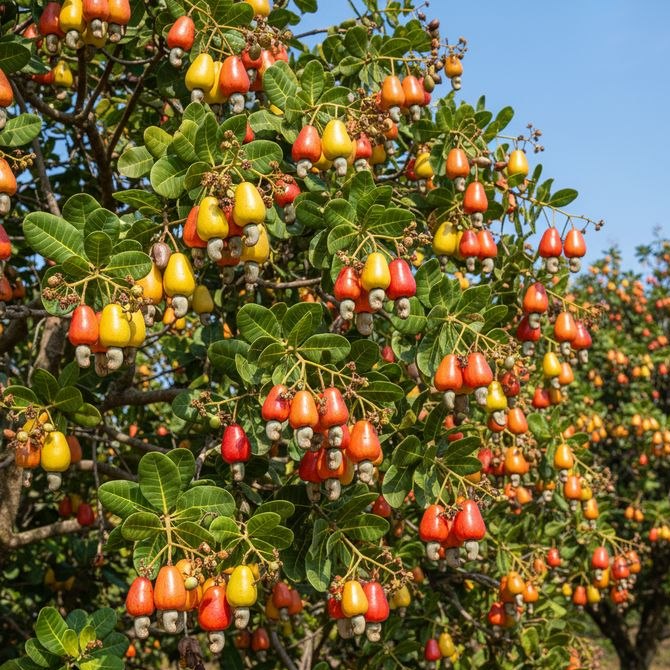
Ghana’s cashew crop follows the dry season. Trees flower at the end of the year, nuts fall in the first months of the next, and most of the year’s raw cashew is collected in a short, intense window. If you buy cashew kernel from Ghana, that window shapes availability, pricing and quality more than anything else.
This calendar sets out the season month by month. Timings are indicative: they move with rainfall and differ between growing areas, so treat the months as a guide rather than fixed dates.
The season at a glance
| Month | In the orchard | In the market | What it means for buyers |
|---|---|---|---|
| November – December | Mature trees begin flowering | Quiet; early crop estimates circulate | A first read on the size of the coming crop |
| January | Fruit matures; first nuts drop late in the month | Early buying begins | Early lots can be uneven in moisture and quality |
| February | Peak collection begins | Buying at full pace | Main window to plan new-crop contracts |
| March | Peak collection | Buying at full pace | Largest volumes of fresh raw nut reach processors |
| April | Late-maturing trees finish | Buying tapers | Remaining volume is smaller and more variable |
| May – June | Season ends in most areas | Residual stocks traded | New-crop raw nut becomes scarce |
| July – October | Off-season; orchard maintenance | Little fresh raw nut | Kernel supply depends on raw nut stored from the season |
Flowering to fall: the biology behind the dates
According to the FAO’s guide to cashew harvesting and post-harvest handling, mature cashew trees in Ghana normally start flowering in late November to December, and the fruit matures roughly 90 to 100 days after flowering. Ripe fruit begins to drop in late January, collection peaks in February and March, and a few late trees continue into April.
The nut is ready when the fruit falls. Nuts collected from the ground and separated from the cashew apple promptly are the ones that dry well and store well — which is why post-harvest handling in these few weeks matters so much for the kernel a buyer eventually receives.
Why the calendar matters if you buy kernel
Moisture and storage
Raw cashew has to be dried to a safe moisture level before it can be stored. Nuts bought at the height of the season and stored properly can be processed for months afterwards. Nuts that go into storage wet lose weight, risk mould and yield poorer kernel.
Outturn varies through the season
Kernel outturn — the share of a raw nut lot that comes out as good whole kernel — is not constant across the season. It is measured by cut test, lot by lot, and it is the single biggest factor in what raw nut is worth. Our guide to cashew grades explains how that kernel is then sorted by size and colour.
Plan contracts around the window
The weeks of peak collection are when raw nut is most plentiful. Buyers who plan their volumes ahead of the season give processors the information they need to buy and store the right quantity of raw nut, rather than competing for what is left afterwards.
Old crop and new crop
Kernel on the market at any moment comes from raw nut bought at some point in the past. Early in the season, buyers are often still being offered kernel processed from the previous harvest. Later, new-crop material comes through.
Neither is automatically better. Well-stored old-crop raw nut, processed properly, gives excellent kernel. Poorly stored raw nut does not, whatever season it came from. But the distinction is worth asking about, because it tells you how long the material has been held and under what conditions.
Why the dates move
Cashew flowers in the dry season and the crop follows the weather. Rain at the wrong moment during flowering reduces fruit set. A late start to the dry season pushes everything back. Growing areas at different altitudes and latitudes within the same country run days or weeks apart.
This is why a calendar is a guide and a phone call is a fact. Anyone contracting significant volume should confirm the position for the season in question rather than relying on a published month.
Planning your buying year
| Period | What to be doing | Why then |
|---|---|---|
| November – December | Open conversations; indicate volumes | Processors are planning how much raw nut to buy |
| January – February | Firm up grades and tonnage | Buying begins; commitments shape purchasing |
| March – April | Contract and schedule shipments | Peak material is moving through processing |
| May – July | Confirm balance of requirements | New-crop raw nut becomes scarce |
| August – October | Review the season; plan the next | Supply comes from stored raw nut |
The pattern to notice is that the useful conversations happen before the harvest, not during it. A processor who knows in December what you will need in March can buy raw nut accordingly. One who finds out in March is competing for what is left. The importing guide covers the contractual side, and outturn explains what a processor is actually assessing when they buy.
Buying from the heart of the crop
Ghana is also moving to process far more of its own crop — see what the raw cashew export ban means for buyers. We are based in Drobo, in Ghana’s Bono Region, one of the country’s main cashew-growing areas. We buy raw cashew directly from farmers during the season, check it openly at purchase, and process it to international specification. If you are a farmer selling in the season, see how we buy; if you are a buyer, see our cashew kernel grades and quality controls.
Planning for the coming season? Tell us the grade, volume and destination and we will tell you what we can commit to.
Source for flowering and harvest timings: FAO, Guide to harvesting and post-harvest handling of cashew nuts. Timings vary with rainfall and growing area.