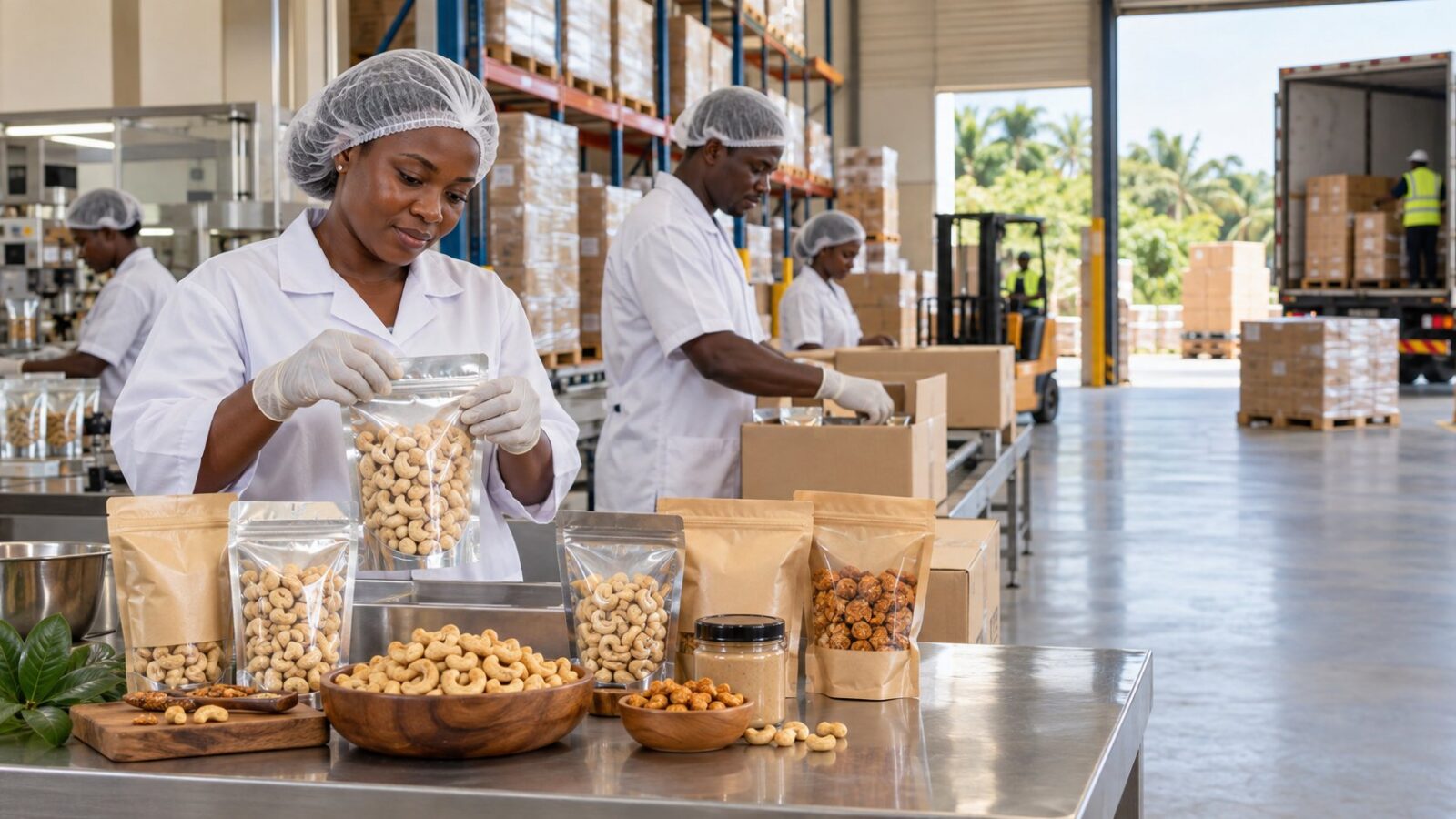
Buying cashew kernel from Ghana is not complicated, but it is exacting. Most problems importers meet are not caused by the product. They are caused by a specification that was too loose, an Incoterm nobody checked, or a document that arrived after the container did.
This is the sequence, in the order it actually happens.
1. Specify the product before you discuss price
A grade on its own is not a specification. Agree all of the following in writing:
- Grade — written in full, for example W320 white whole kernels
- The standard it is graded against. Most international cashew contracts reference the Association of Food Industries (AFI) specification
- Maximum moisture content
- Defect tolerances for that grade
- Packaging — format, net weight per carton, whether vacuum packed
- Shelf life from the date of packing
If you are not certain which grade suits your product, the grades guide explains what each one is for.
2. Agree the Incoterm, and know what it moves
Incoterms decide who arranges what, who pays for what, and — most importantly — the point at which risk passes from seller to buyer. Three are common in cashew.
| Incoterm | Seller arranges | Buyer arranges | Risk passes |
|---|---|---|---|
| FOB (Free On Board) | Export clearance and delivery onto the vessel at the port of shipment | Ocean freight, insurance, import clearance, inland delivery | Once goods are on board at the port of shipment |
| CFR (Cost and Freight) | The above plus ocean freight to the named destination port | Insurance, import clearance, inland delivery | Still at the port of shipment, even though the seller pays the freight |
| CIF (Cost, Insurance and Freight) | The above plus minimum marine insurance | Import clearance, inland delivery | Still at the port of shipment |
The detail that surprises first-time importers is in the last column. Under CFR and CIF the seller pays for freight, but risk has already passed to the buyer at loading. If something happens mid-ocean it is the buyer’s claim, not the seller’s — which is exactly why the insurance question matters.
We quote FOB Tema as standard, with CIF and CFR available to most destinations on request.
3. Use the right HS code
The Harmonised System code determines the duty your shipment attracts and the paperwork customs expects. Cashew sits in three places depending on how it has been processed.
| HS code | Covers | Typical description |
|---|---|---|
| 0801.31 | Cashew nuts, in shell | Raw cashew nut (RCN) as harvested |
| 0801.32 | Cashew nuts, shelled | Kernels — W180 to W450, scorched, splits, pieces |
| 2008.19 | Nuts, otherwise prepared or preserved | Roasted, salted, flavoured or otherwise prepared kernels |
Two notes. First, the duty rate and any preferential treatment depend entirely on your destination country and any trade agreement in force — check your own tariff schedule rather than relying on a supplier’s summary. Second, roasted product is classified differently from raw kernel, so if you are importing both, they are separate lines.
4. Know which documents you need
| Document | What it proves | Issued by |
|---|---|---|
| Commercial invoice | What was sold, at what price, on what terms | The exporter |
| Packing list | Cartons, net and gross weights, lot references | The exporter |
| Bill of lading | Contract of carriage and title to the goods | The shipping line or forwarder |
| Certificate of origin | Where the goods were produced — often needed for tariff treatment | Chamber of commerce or authorised body |
| Phytosanitary certificate | The consignment meets plant-health requirements | The national plant protection authority |
| Certificate of analysis | Lab results for the specific lot — moisture, defects and more | The exporter or an independent laboratory |
| Fumigation certificate | Treatment applied, where the destination requires it | Licensed treatment provider |
Requirements vary by destination. Confirm with your customs broker early, because a missing certificate is a demurrage problem, not a paperwork problem.
5. Settle payment terms both sides can live with
Three structures are common, and they trade security against cost and speed.
- Letter of credit. A bank guarantees payment once the seller presents conforming documents. Strong protection for both sides, but slower and it carries bank charges. Documents must match the credit exactly — small discrepancies cause real delays.
- Documentary collection. Documents are released through banks against payment or acceptance. Cheaper than a letter of credit, less protective.
- Telegraphic transfer. Often a deposit with the balance against shipping documents. Fast and cheap, and it depends on trust, which is why it usually follows a first successful shipment rather than preceding it.
6. Ask for a sample, and agree inspection
Sample lots drawn from production tell you more than a specification sheet. Agree in advance whether a pre-shipment inspection will be carried out, by whom, and what happens if the consignment does not meet the contracted specification. That last point is the one most often left vague and most often needed.
7. Understand the season you are buying into
Cashew is an agricultural product with a concentrated harvest. Availability, and to a degree price, follow it. Planning volumes ahead of the buying season gives a processor the information they need to buy and store the right quantity of raw nut. Our Ghana harvest calendar sets out the months.
8. Plan for arrival
On arrival your consignment clears customs and, as a food product, may be subject to official controls in the destination market. Requirements differ significantly between the EU, the UK, the US and elsewhere, and they change. Your broker and your own food-safety team should confirm what applies before the vessel sails, not after it berths.
The mistakes that cost the most
- Agreeing a grade without a standard. Grade codes mean what the referenced standard says they mean, and nothing more.
- Assuming CIF means the seller carries the risk. It does not.
- Leaving the out-of-specification remedy unwritten. Decide it while everyone is relaxed.
- Classifying roasted product as raw kernel. Different code, different treatment.
- Booking with no allowance for document turnaround. Under a letter of credit especially, documents drive the timetable.
Buying from us
We process in Drobo, Bono Region, and ship FOB Tema. See our kernel grades, the checks behind every lot, or send us grade, volume and destination for a firm quotation. If you would rather talk it through, contact us.